Both machines get sold as "body contouring", both get shown to the same client standing in front of the same mirror, and they do almost opposite things. Buying the wrong one first is how a treatment room ends up with a machine that gets wheeled out twice a month.
The short answer
Cryolipolysis removes fat. EMS builds muscle. If the tissue you can pinch is the problem, you want cooling. If the tissue you cannot pinch is the problem, you want stimulation.
Everything below is the detail behind that sentence.
What cryolipolysis actually does
Adipocytes crystallise at temperatures the surrounding dermis, vessels and nerve tissue tolerate. That gap is the whole basis of the treatment: cool the fold to roughly -10C, hold it, and the fat cells undergo apoptosis while the skin above them does not. The body clears the damaged cells over the following eight to twelve weeks, which is why nobody walks out of a cryo session looking different.
Vacuum matters more than most brochures admit. Suction draws the fold into the cup so the cooling plates contact the tissue on both faces. Cooling from one face treats half as much and takes twice as long.
Practical buying points:
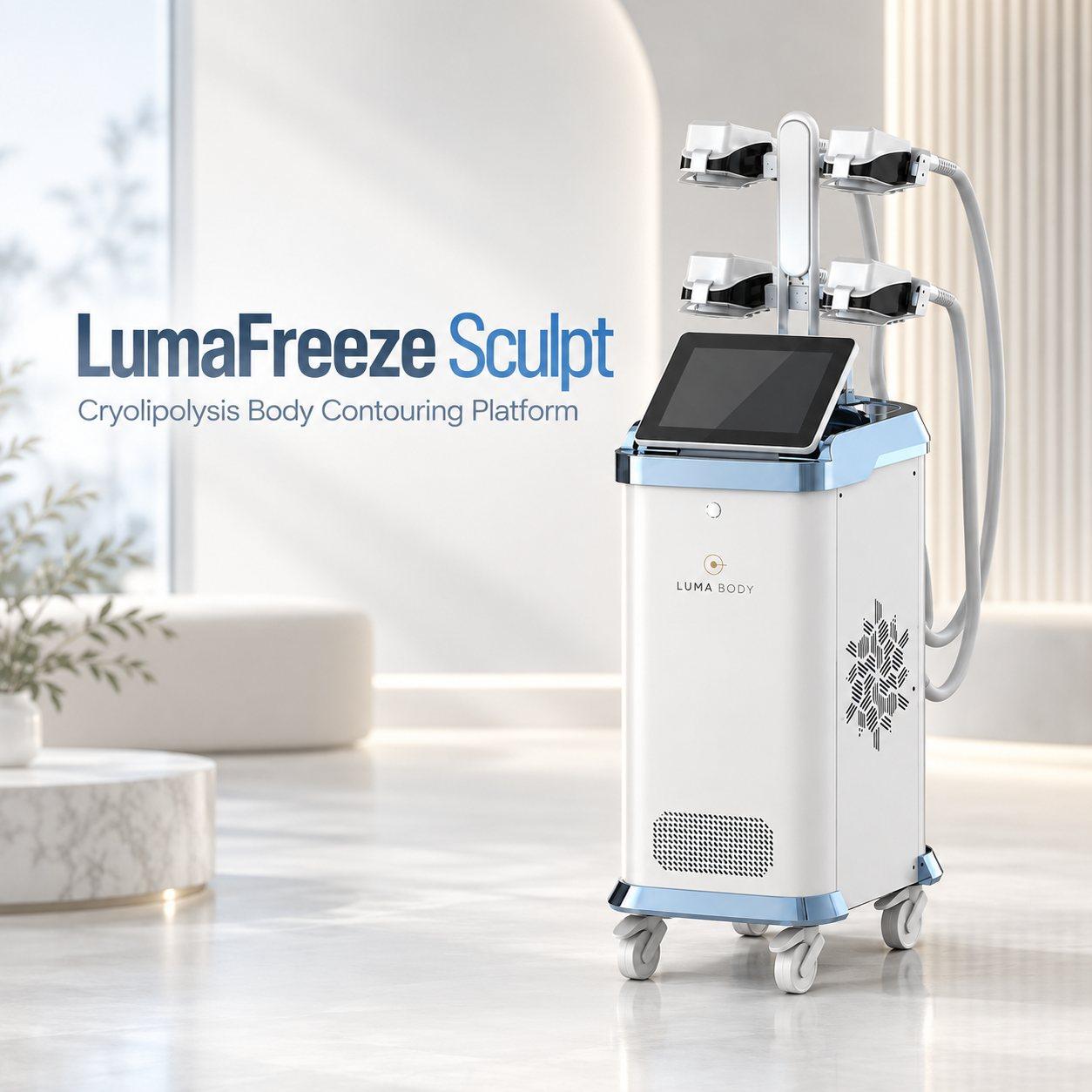
- Handle count decides your day rate. Two areas at once halves chair time per client. Four handles across two sizes — the configuration on the LumaFreeze Sculpt — lets you run flanks and abdomen in one appointment.
- Cup geometry decides what you can sell. A submental cup opens double-chin treatment, which is a different price point and a different client.
- Suction to 80 kPa is the working range. Below that the fold slips.
What EMS body sculpting actually does
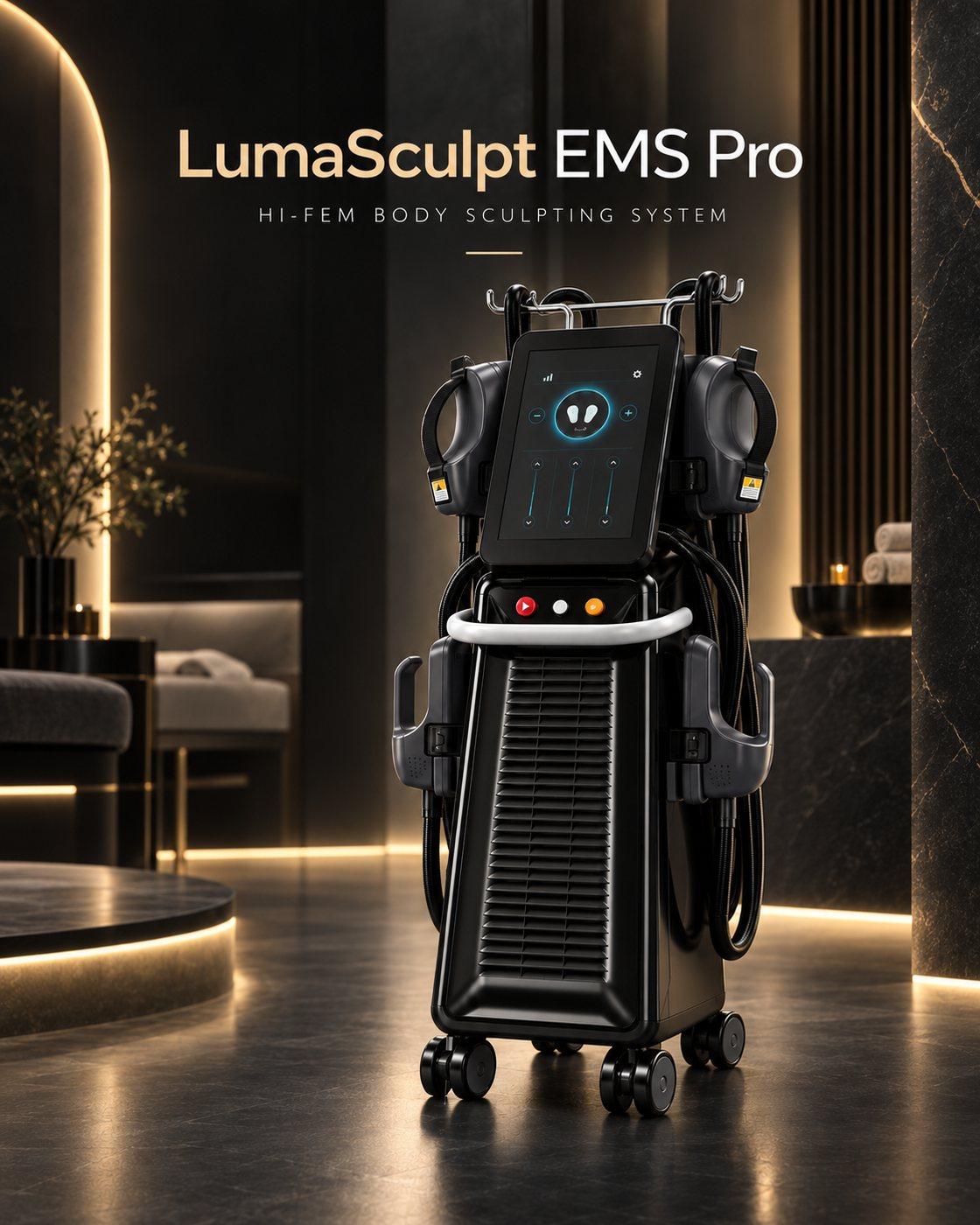
HIFEM applies a rapidly changing magnetic field that depolarises motor neurons, producing contractions no voluntary effort can match — thousands per session, at intensities the client could not hold for a second on their own. The muscle responds the way muscle responds to overload: it adapts.
The number people quote is field strength. Coils reaching 5.8 tesla, at 1–150Hz, are the professional range; below about 3T you are selling a sensation rather than a stimulus. Some platforms add synchronous RF to warm the tissue during contraction, which shortens the warm-up phase.
The commercial shape is different from cryo, and this is the part that gets overlooked. A HIFEM course is four to six sessions over two or three weeks. A cryo course is one to three sessions over three months. The EMS client is in your building far more often, which matters if you sell skincare, injectables or anything else on the way past reception.
Where vacuum-RF fits
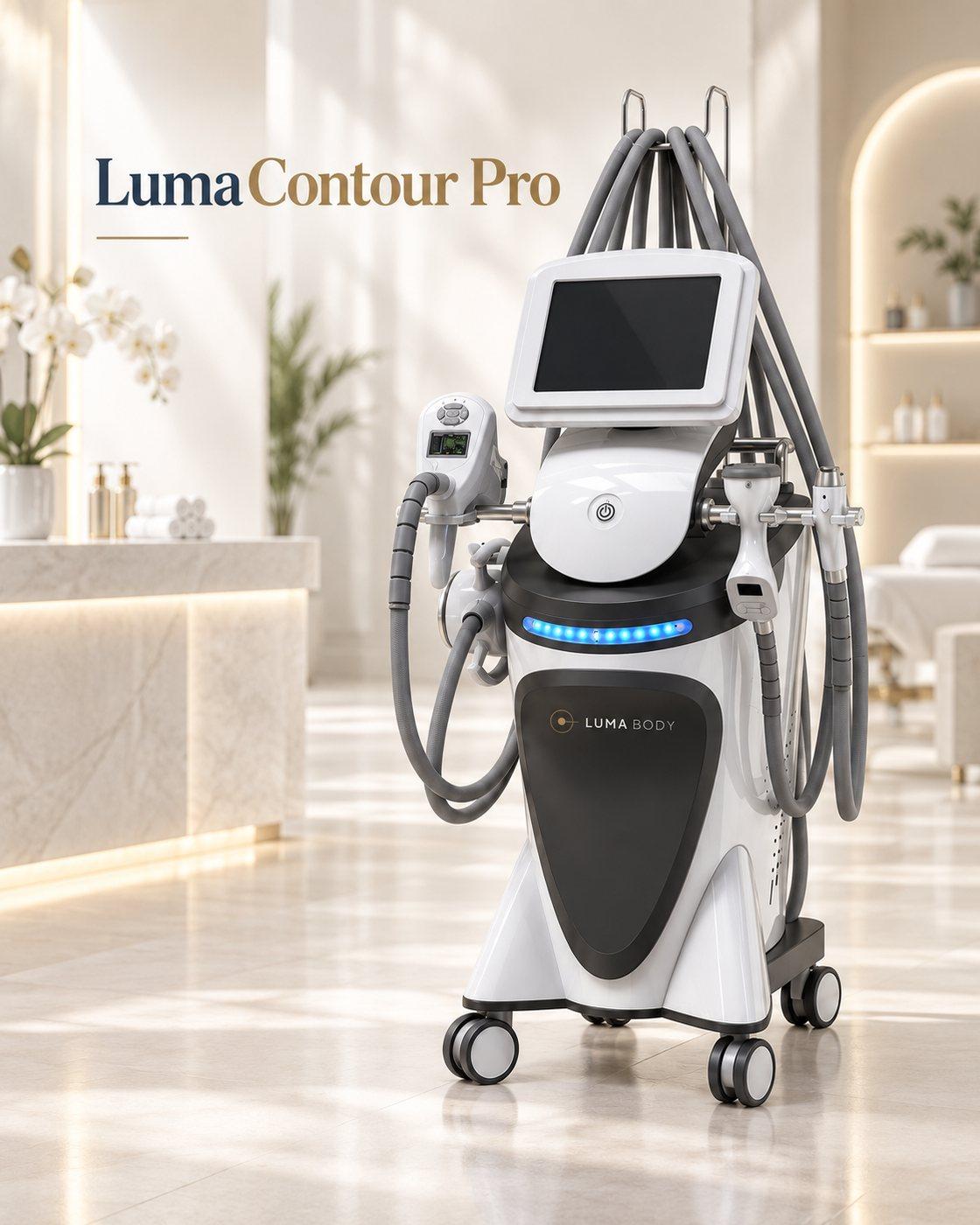
There is a third category that does neither: vacuum, roller massage, RF and sometimes a low-power laser diode on the same trolley — the LumaContour Pro configuration. It works on circumference, skin texture and the appearance of cellulite rather than on fat volume or muscle mass.
It is the cheapest way into the category, it is the easiest to staff because the treatment is essentially a mechanised massage protocol, and it is the one to buy if your bookings problem is that clients want something for their thighs and you have nothing to offer. It is not a substitute for either of the other two.
Choosing when you can only buy one
| Your situation | Buy |
|---|---|
| Client base skews 35+, wants inches off flanks and abdomen | Cryolipolysis |
| Client base skews under 35, gym-going, wants definition | EMS |
| Post-partum clients, abdominal separation, core weakness | EMS |
| You need to fill quiet weekday slots with repeat visits | EMS |
| You want the highest revenue per single appointment | Cryolipolysis |
| Budget under $10k, or you need a treatment any staff member can run | Vacuum-RF |
| Clients ask for cellulite and skin texture, not fat loss | Vacuum-RF |
The consultation is the machine
Body contouring has the highest refund rate of any category in aesthetics, and almost all of it traces to one failure: selling fat reduction to somebody whose problem was muscle, or muscle to somebody whose problem was fat.
The test costs nothing. Ask the client to stand and pinch. If a fold comes away between finger and thumb, there is fat to remove. If the abdomen is firm and nothing lifts, cooling it will change very little and the client will tell everyone it did not work.
Do that assessment properly and either machine pays for itself. Skip it and neither one will.
What it costs to start
At clinic pricing, delivered, the three sit at $8,910 for vacuum-RF, $11,900 for four-handle cryolipolysis and $13,900 for HIFEM. Against a typical US package price for a course of body contouring, a machine in this range is generally covered inside the first fifteen to twenty-five clients — the arithmetic is the same shape as the one in our HIFU machine cost guide.
The larger cost is the one nobody lists: a treatment room occupied for an hour. That is the number to protect, and it is the reason handle count and session length deserve more attention than the sticker price.