These two get sold as if one replaced the other. They did not. They break pigment by different mechanisms, and the cheaper one is still the right buy for a lot of practices.
The mechanism
Q-switched lasers fire nanosecond pulses. The pulse is short enough to confine energy to the target particle, which heats rapidly and fractures. It is a largely photothermal process — heat does the work.
Picosecond lasers fire pulses roughly a thousand times shorter. The pulse ends before heat can conduct out of the particle, so the energy has nowhere to go and the particle fractures under the resulting pressure wave. The process is photomechanical rather than photothermal.
Smaller fragments are easier for the body to clear, which is the practical argument for picosecond. Less deposited heat is the argument for comfort.
Where each one wins
Q-switched Nd:YAG is genuinely good at dark ink. 1064nm reaches deep black and blue-black pigment, and passes through epidermal melanin more safely than shorter wavelengths, which matters on darker skin. Frequency-doubled 532nm handles red and superficial pigment. For a practice whose tattoo work is mostly black ink, a Q-switch does that job at a fraction of the price.
Picosecond wins on multi-coloured and stubborn ink, resistant pigment that has stopped responding to nanosecond treatment, and toning protocols where deposited heat is the limiting factor.
Two things to check before you pay pico prices
Check the actual pulse width. Some machines are marketed as picosecond while their own specification sheet states Q-switched Nd:YAG. If the spec sheet says nanoseconds, it is a Q-switch, whatever the brochure calls it. Ask for the pulse width in the specification, not the product name.
Check the beam profile. A top-hat beam distributes energy flat across the spot; a Gaussian beam peaks in the centre. Top-hat is what allows fluence to be raised without a hot core in every pulse, and it is the difference between a consistent result across a treated area and a mottled one.
What we sell, named honestly
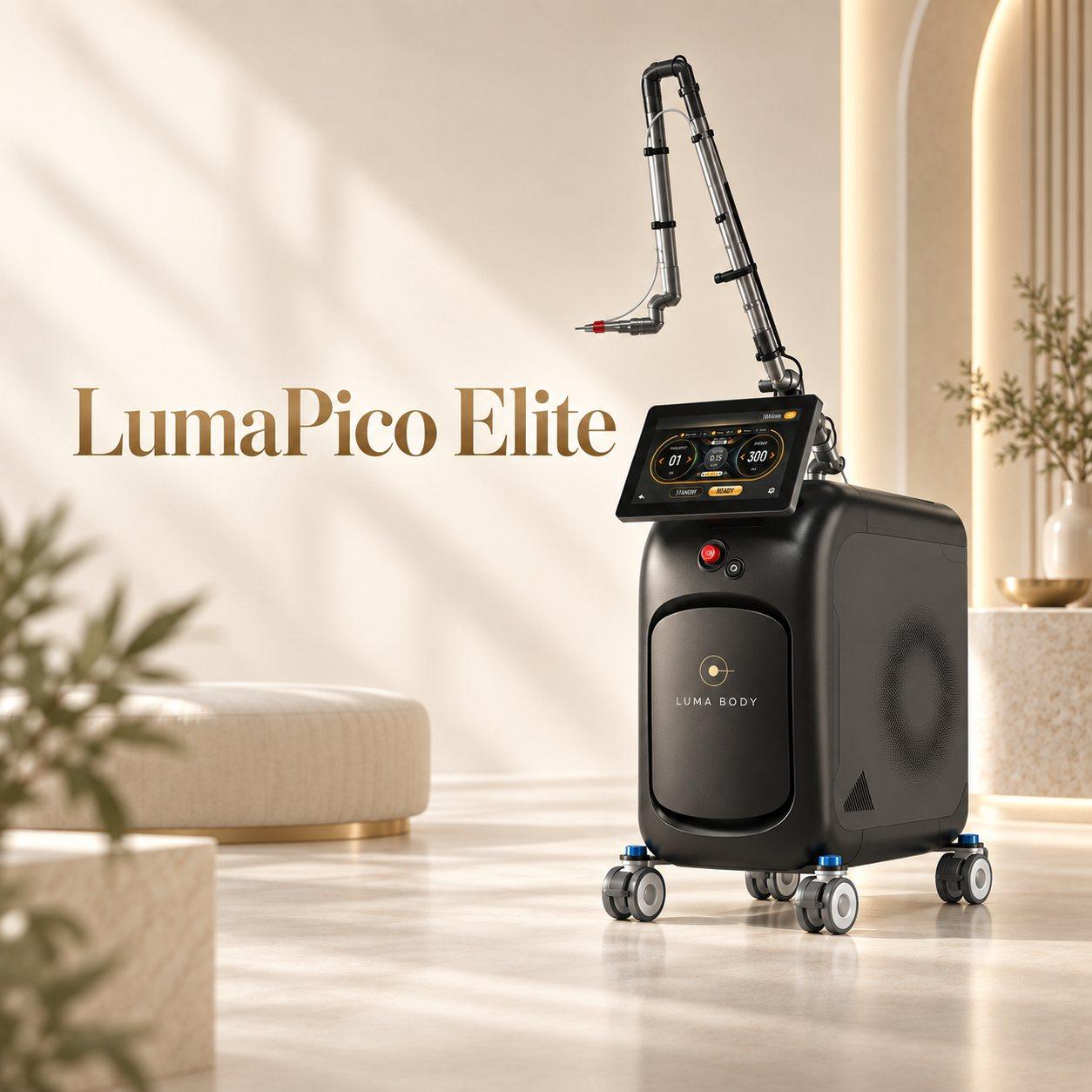
The LumaPico Elite is a genuine picosecond platform: 500ps at 1064nm, 350ps at 532nm, top-hat, with zoom, DOE, MLA and dye handpieces.
We do not currently sell a Q-switched laser. If your work is mostly black ink and budget is the deciding factor, a Q-switch from another supplier may be the better buy. Just make sure its specification sheet says what its brochure says.
If a supplier is vague about which of the two you are being sold, that is the answer.