Tattoo removal is one of the few aesthetic treatments where the client has no alternative: there is no cream, no device at home, and no way to do it gradually themselves. That is why the machine is expensive, and why it pays.
The range
$8,000–$20,000. Nanosecond Q-switched Nd:YAG. These work, especially on dark ink, and they are how most clinics enter the category. The pulse is around a thousand times longer than a picosecond pulse, so more of the energy arrives as heat.
$35,000–$60,000. Picosecond platforms. Shorter pulses fracture pigment mechanically rather than heating it, which usually means fewer sessions and less thermal load on the surrounding skin.
$70,000–$120,000+. Branded picosecond systems, where a share of the price is the name clients search for by itself.
The difference between the first two groups is explained in full in picosecond or Q-switched. If a supplier is vague about which one they are selling you, read that first.
What actually matters on the specification sheet
- Pulse width, in picoseconds or nanoseconds. It is the whole argument. A brochure that says "pico" while the specification says Q-switched is describing a nanosecond laser.
- Both wavelengths. 1064nm reaches deep black and blue ink and is safer on darker skin; 532nm handles red, orange and brown. One without the other halves what you can treat.
- Beam profile. A top-hat beam spreads energy flat across the spot instead of peaking in the middle, which is what lets an operator raise fluence without a hot core in every pulse.
- Spot size range. Zoom optics let the operator change spot size without changing handpiece, and spot size is how fluence is controlled in practice.
- Extra handpieces. Diffractive (DOE) and micro-lens (MLA) optics turn the same console into a toning and texture device on days with no tattoo work.
The arithmetic
The numbers below are illustrative, not a promise, and local pricing varies widely — but the shape of the calculation is the same everywhere.
A clinic charging in the low hundreds per session for a medium tattoo, running one or two sessions a day, and treating each client six to ten times over a course, recovers a machine in the picosecond tier within its first year of steady bookings. Three things drive that:
- Courses, not sessions. One acquired client returns repeatedly, at six to eight week intervals.
- No consumables. Unlike microneedling or HIFU, there is no cartridge per treatment. The cost per session is time and electricity.
- A second revenue line. Pigmented lesions, sun damage and toning fill hours that tattoo work does not.
What breaks the arithmetic is buying a machine that cannot treat every client who walks in. A single-wavelength system turns away colour work; an underpowered one turns a six-session course into a twelve-session one, and clients stop coming back before they finish.
Consent and expectations
Tattoo removal generates more complaints than any other laser treatment, and almost all of them trace to expectations rather than technology. Quote a range of sessions, never a number. Photograph before every session. Explain that some inks — particularly whites, yellows and some cosmetic pigments — can darken or resist clearing. A client who was told that in advance is a client who stays.
What we sell
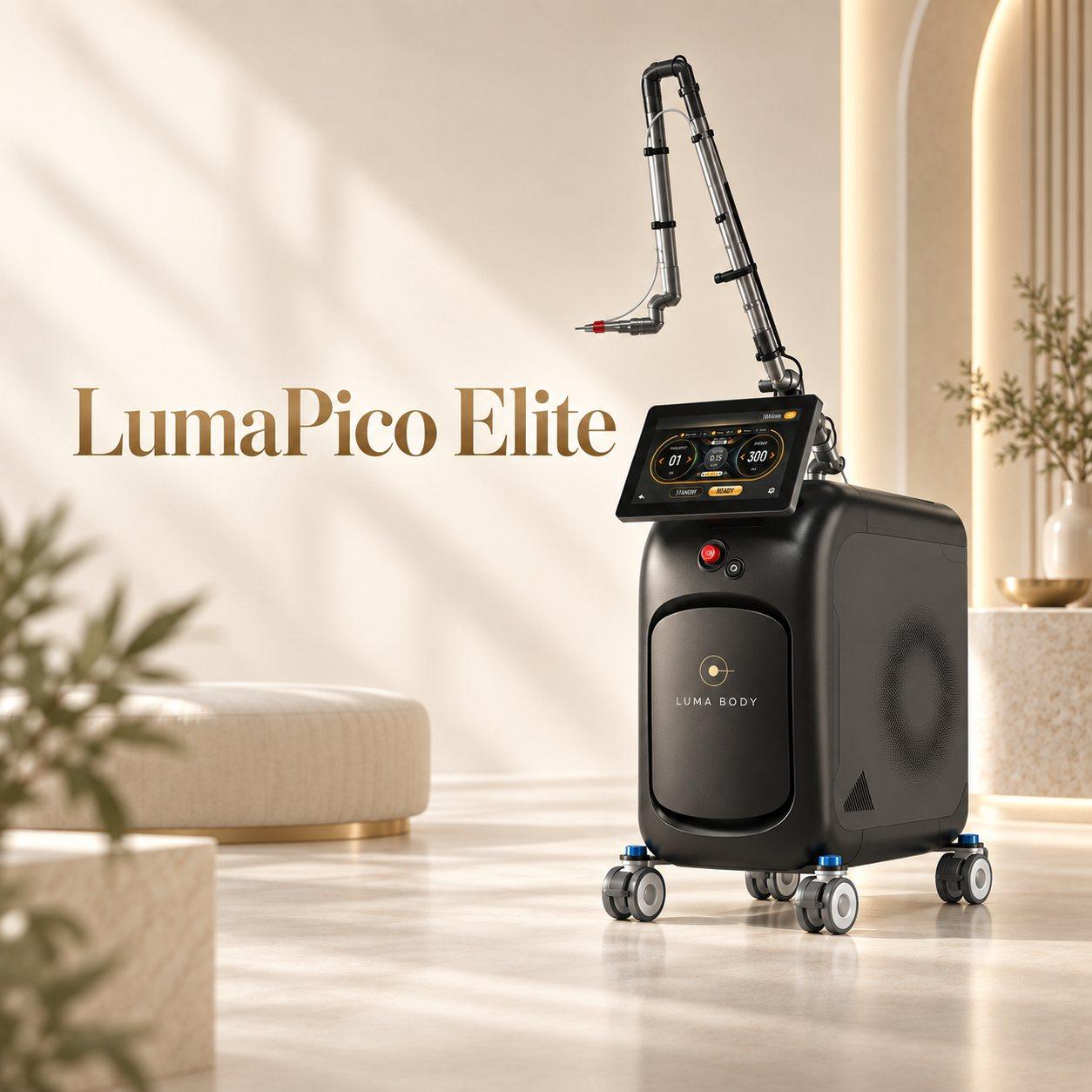
The LumaPico Elite is $28,900 delivered: 500ps at 1064nm and 350ps at 532nm, a top-hat beam, a seven-position zoom handpiece from 2 to 10mm, DOE and MLA handpieces for toning and 585/650nm dye handpieces for stubborn colours. A 350ps ultra-short configuration is available as an option, priced openly in the configurator.
That price is final and delivered in the US and Canada — nothing is added at checkout and nothing is due on arrival — with operator training and a 12-month machine warranty included. It can be paid in full, or 50% before we prepare your order and 50% once it is ready to ship.