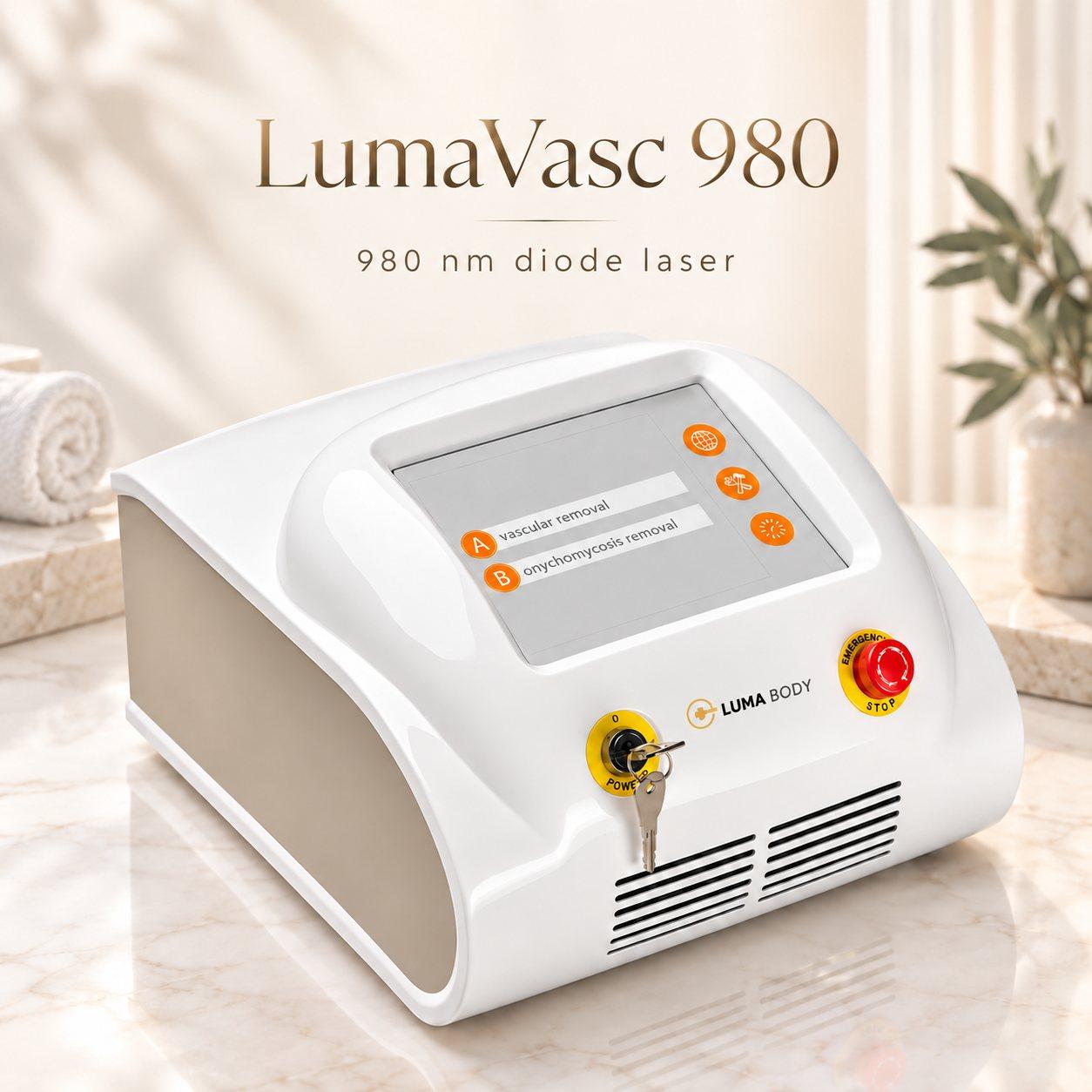
The LumaVasc 980 is $2,710. That is the final delivered price to your practice in the US or Canada, with nothing to pay on arrival. It is a small tabletop 980nm diode with a fibre-optic handpiece and four spot sizes. This guide covers what you get for that price, what a session costs you to run, and how to work out payback from your own numbers.
For the physics of why 980nm is used on small vessels, read 980nm spider vein laser machines: what 980nm actually does. This guide covers the money.
What you get for the price
| Item | LumaVasc 980 |
|---|---|
| Wavelength | 980nm diode |
| Spot sizes | 0.5 / 1 / 2 / 3mm |
| Repetition rate | Up to 6 Hz |
| Delivery | Fibre-optic handpiece |
| Cooling | Air |
| Console | 8.4" touchscreen |
| Power | 110V 60Hz or 220V 50Hz, no extra charge |
| Warranty | 2 years machine, 3 months handpiece |
| Training | Online, for your team |
| Price | $2,710, delivered |
A spare fibre handpiece can be ordered separately. Most owners keep one on the shelf. That way a damaged fibre does not cancel a day of bookings.
What it treats, and what it doesn't
980nm is absorbed by both haemoglobin and water. That makes it a tool for small, individual vessels:
- Spider veins and facial telangiectasia
- Small vascular lesions and localised redness
- Nail (onychomycosis) protocols
It traces vessels one at a time. It is not a tool for diffuse redness across a whole cheek, which is IPL work. It is also not a tool for large, bulging leg veins. Those need a clinician who assesses veins.
Be honest with yourself about this when you estimate demand. Count small facial and leg spider veins only.
Who may operate a laser, and under what supervision, depends on where you practise. Confirm the rules that apply to your clinic before you book the first client.
Spot sizes and fibre delivery
The spot size is the part of a vascular laser that matters most day to day. The spot should match the vessel. A 0.5mm spot on a fine facial thread puts the energy where the vessel is. A 3mm spot on the same thread mostly heats the skin around it.
A machine with only one or two large spots is a poor vascular laser, whatever its other numbers. Four spots from 0.5 to 3mm cover fine facial vessels through to small leg spiders. The training protocols set out which to use where.
Fibre delivery means the light travels down a thin optical fibre to a pen-like handpiece. It is light and precise, which suits tracing. It is also the wear part:
- Fibres break if bent too tightly. Route the cable and store the handpiece the way the training shows.
- The fibre tip needs cleaning and inspection. A dirty or chipped tip delivers less energy than the screen says.
- The handpiece warranty is shorter than the machine's. It is 3 months against 2 years, because handpieces are handled all day. Budget for a spare.
The repetition rate, up to 6 Hz, sets how fast you can move along a vessel. Short, fine facial work rarely needs more.
What a session costs you to run
There is no flashlamp to replace and no cartridge to buy per client. The direct costs are time, disposables, fees and fibre wear.
The table below is a worked example. Replace every figure with your own.
| Cost per session (assumptions) | Amount |
|---|---|
| Operator time: 30 minutes at $35/hour loaded | $18 |
| Disposables: gloves, wipes, cooling, aftercare | $6 |
| Card fees: 3% of a $200 session | $6 |
| Fibre handpiece wear allowance | $10 |
| Direct cost per session | $40 |
The fibre allowance is a placeholder. Ask for the spare fibre price and its expected life in writing, then divide one by the other. If your operator is paid more, or sessions run longer, adjust the first line.
Rent and general overhead are left out on purpose. The room exists whether this machine is in it or not. What you want to know is how fast the machine earns back its own cost.
What clinics charge, and the payback arithmetic
Vascular laser sessions are usually priced by area or by time block. Prices vary a great deal by city. Before you set yours, check the menus of three clinics within driving distance. The example below uses $200 per session as an assumption, not a market claim.
Net per session: $200 − $40 = $160
Sessions to cover the machine: $2,710 ÷ $160
Weekly net at different volumes:
| Sessions per week | Weekly net at $160 |
|---|---|
| 3 | $480 |
| 6 | $960 |
| 10 | $1,600 |
Weeks to cover the machine: $2,710 ÷ your weekly net.
To set a realistic starting volume, count the vascular clients you currently refer out. That is demand you already have.
Many clients book more than one session. How many each client needs is for the treating clinician to judge, so do not build repeat visits into your plan until you see your own rebooking rate.
Nail protocols are a separate service with their own price. Add them to the weekly figure only if you will actually market them.
If you would rather spread the cost, leasing vs buying sets out what each route actually costs. For how this machine ranks against other first purchases, see which machine to add to a med spa first, ranked by payback.
What to check on any 980nm unit
Whoever you buy from, get these in writing before you pay:
- Spot sizes. You want several, down to 0.5mm. A single large spot is a hair or body laser being sold as vascular.
- Maximum output and energy range. Ask for the figures and how they are set from the screen.
- Fibre handpiece price and expected life. This is your main running cost.
- Handpiece and machine warranty, separately. Know what each covers and for how long.
- Voltage. Make sure it matches your wall, and confirm there is no surcharge.
- Training. Who delivers it, in what format, and whether it covers settings by vessel size.
- The delivered price. Make sure it is the whole amount, with nothing to pay on arrival.
The broader list is in eleven things to check before buying any med-spa machine. The ordering process is explained in how buying a clinic machine direct works.
Where it fits next to IPL
A 980nm laser and an IPL do different jobs:
- IPL covers an area. It treats diffuse redness and pigment across the face.
- 980nm traces individual small vessels that IPL handles poorly.
Clinics with a lot of redness work often run both. If you already own the LumaPulse IPL ($3,270), the LumaVasc 980 covers the vessels the IPL leaves behind. If you own neither, read what an IPL machine costs and decide which kind of redness your clients bring in most.
For Spanish-speaking teams, the same subject is covered in Láser 980nm para arañitas vasculares.