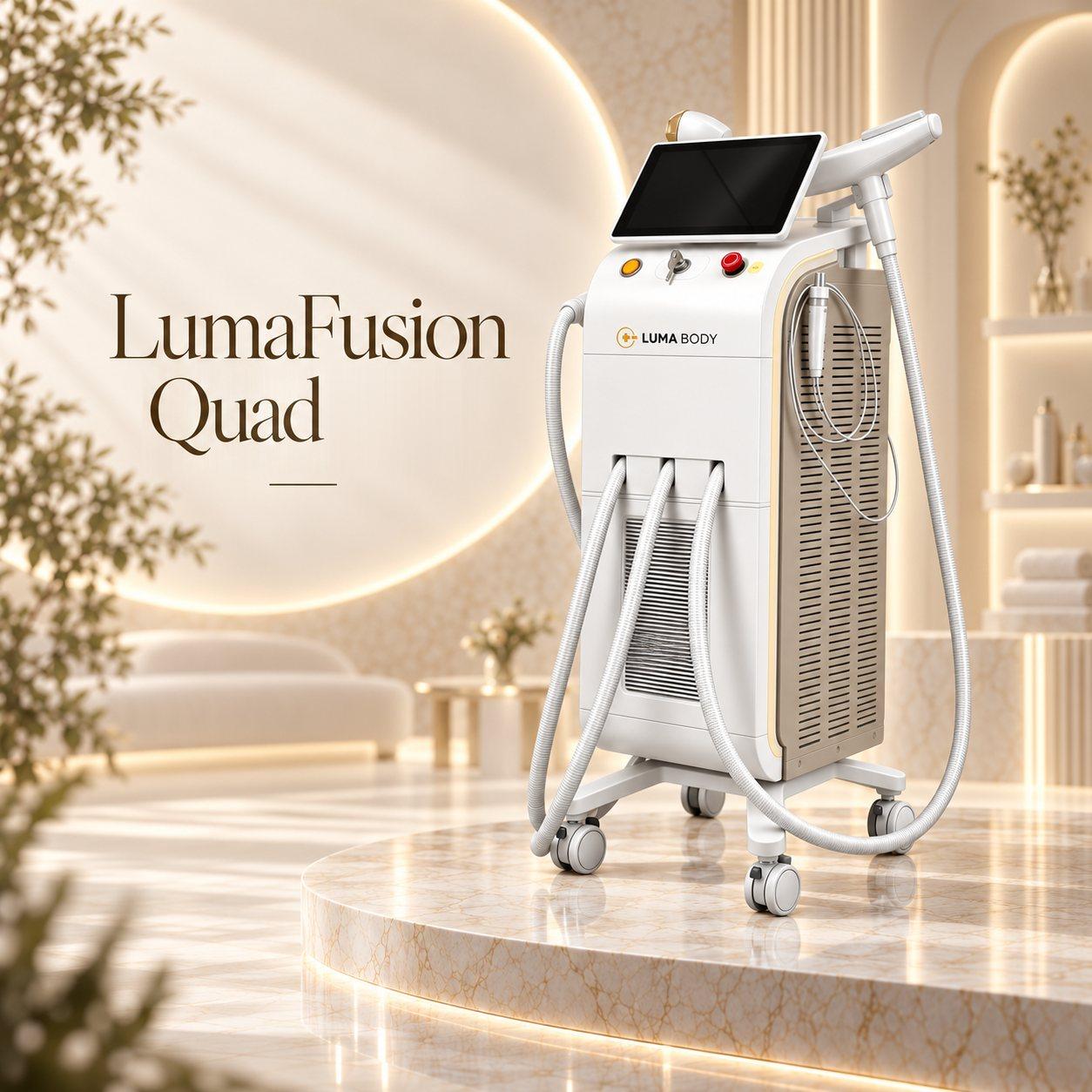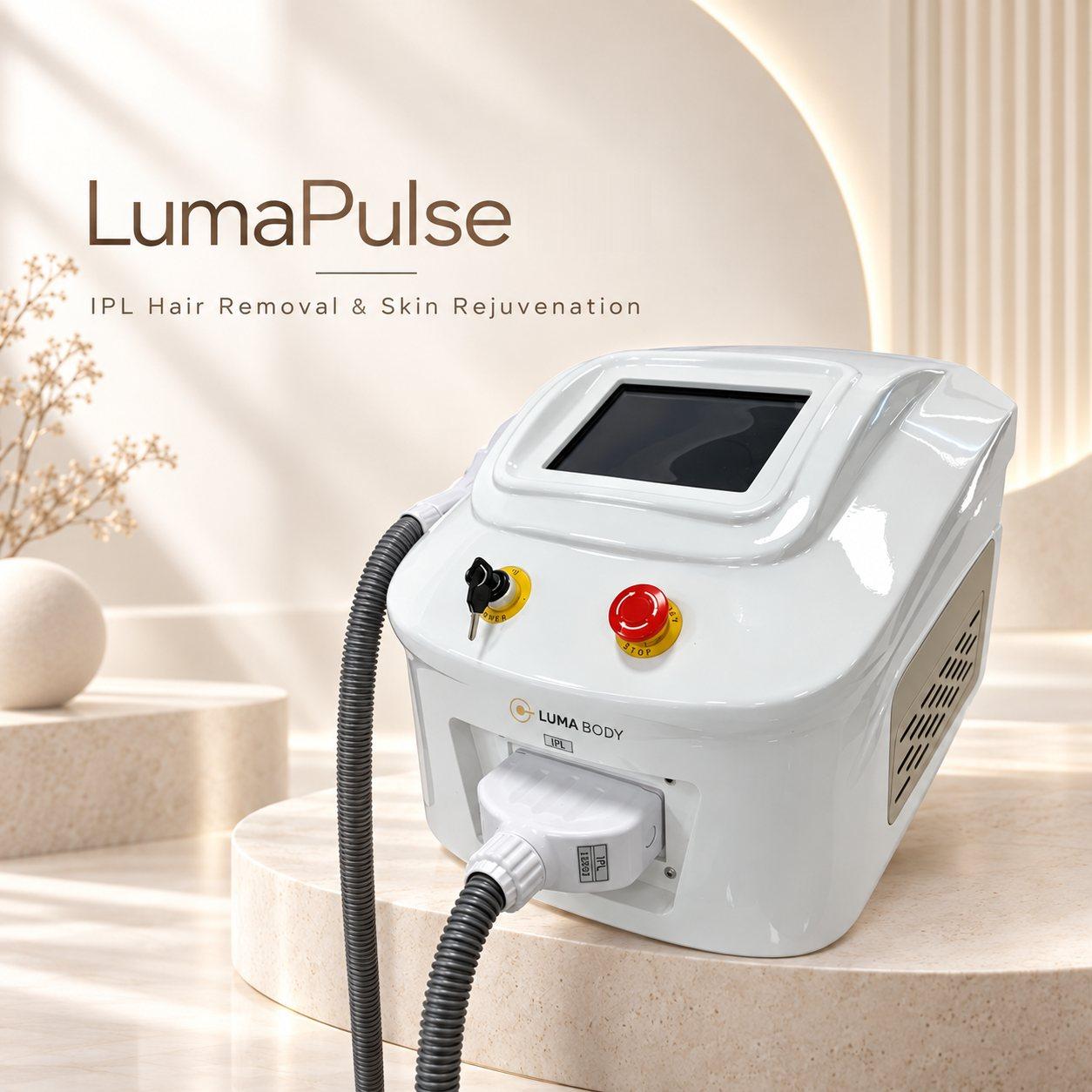
A med spa can buy a professional seven-filter IPL, the LumaPulse IPL, for $3,270, final delivered price. The same IPL handpiece specification also comes on the LumaFusion Quad, a console that adds a diode laser, Nd:YAG and RF, for $11,120. Both are delivered to your practice in the US or Canada, nothing to pay on arrival.
Which one fits depends on how much of your diary will be hair removal. The rest of this guide covers what IPL earns its place doing and what it costs to run.
The two ways to buy IPL
| LumaPulse IPL | LumaFusion Quad | |
|---|---|---|
| Price, delivered | $3,270 | $11,120 |
| Platforms | IPL only | Diode laser, IPL, Nd:YAG, RF |
| IPL filters | 420 / 510 / 560 / 585 / 640 / 690 / 755nm | Same seven |
| IPL fluence | 10–50 J/cm² | 10–50 J/cm² |
| IPL power | 800 W | 800 W |
| IPL window | 15x50mm | 15x50mm |
| Cooling | Air + water + sapphire contact | Water + TEC + sapphire contact |
| Console | 8" touchscreen, tabletop | 14.4" touchscreen, floor-standing |
| Power supply | 110V or 220V | 110V or 220V |
| Warranty | 2 years machine, 3 months handpiece | 2 years machine, 3 months handpieces |
On IPL alone the two are the same tool. The difference is everything around it. The LumaPulse is a compact unit for a room that does skin treatments. The Quad is for a clinic that wants hair removal, IPL, tattoo and pigment work and RF tightening from one footprint. We cover the trade-offs of that approach in when a multifunction platform is the right buy.
What a med spa sells from an IPL
IPL is broadband light from a flashlamp. A filter blocks everything below its cut-off number, so the filter decides the treatment.
| Filter | Typical use |
|---|---|
| 420nm | Acne protocols |
| 510nm | Superficial pigment, freckles |
| 560nm | Pigment, sun spots, photo-rejuvenation |
| 585nm | Diffuse redness, vascular protocols |
| 640nm | Hair reduction, deeper settings |
| 690nm | Hair reduction |
| 755nm | Hair reduction, finer hair |
That spread is the point of IPL. One handpiece moves between a photofacial at 10am, a redness client at 11am and an underarm at noon, with a filter change in between.
It has limits worth knowing before you build a menu around it. IPL suits diffuse redness better than individual vessels. Clinics that want to treat single spider veins usually add a dedicated device such as the LumaVasc 980. Most operators are also more cautious with IPL on darker skin types than with a 1064nm diode. If your client base is broad, read what a hair removal machine needs for darker skin.
Filters and handpiece: what to check on any IPL
- Filter count and cut-offs. Seven filters means seven set-ups. Two or three filters means hair and basic rejuvenation, nothing more.
- Filter material. Sapphire filters handle heat and cleaning better than glass. Ask what they are made of, and what a replacement costs if one is dropped.
- Window size. A 15x50mm window covers a cheek or forearm in a few passes. Small windows make legs and backs slow.
- Fluence range. 10–50 J/cm² gives room to start low on a new client and work up.
- Contact cooling. A cold sapphire surface on the skin is standard on professional units. Check it is there, not just a fan in the console.
- Handpiece warranty. The handpiece holds the lamp and does the work. Ours carry 3 months. Know the term on whatever you buy.
Consumables and running costs
The flashlamp is the consumable. Every IPL lamp is rated for a number of shots and then replaced. Ask for the lamp price and the rated shot count in writing, and divide the first by the second. That is your lamp cost per pulse.
A full-face session is commonly somewhere around 60 to 150 pulses with a 15x50mm window, depending on face size and number of passes. Time a few real treatments in your first weeks and use your own count.
The rest is small but real:
- Coupling gel, used on every treatment
- Distilled water for the cooling circuit
- Replacement filters, if one cracks
- Eye protection for operator and client
There is no lamp on a diode laser. Its bar is rated in the tens of millions of shots, which is the main reason high-volume hair clinics choose diode. For more on lamp economics, see what an IPL machine costs to run.
What to charge per session
Start with your floor price, then price from your local market.
Floor price per session:
lamp cost per pulse × pulses per session + gel and disposables + operator time + room cost per hour × session length
Anything below that loses money. Above it, look at what nearby clinics list for a full-face photofacial, a redness treatment and hair reduction by area, and decide where you sit.
A few practical points:
- Price skin treatments as a series. Photo-rejuvenation and pigment clients are usually booked as a course of sessions a few weeks apart. Sell the package at booking.
- Price hair by area and by time. IPL is slower than diode on large areas. Time a full leg before you publish a price for one.
- Do not race the diode clinics on hair. If a clinic down the road runs a diode laser on volume, compete on the skin menu instead.
A worked example, on assumptions you should replace with your own. Say you charge $250 for a full-face IPL session and run 4 sessions a day, 4 days a week. That is 16 sessions, or $4,000 a week in revenue before costs. To see how many sessions cover the machine, divide $3,270 by your margin per session after the floor costs above. Use your own price, your own booking rate and your own lamp figure.
When to pick IPL over a diode laser
| Your clinic | Better first buy |
|---|---|
| Skin-led menu: pigment, redness, photo-ageing, acne, some hair | IPL |
| Hair removal is most of the revenue, large areas, high volume | Diode laser |
| Broad range of skin types booking hair removal | Diode laser with 1064nm |
| General aesthetic clinic, one room, wants both | Multifunction console |
If hair is the business, look at the LumaDiode TriWave at $10,320 and read choosing a diode laser for a med spa. The technical side of the comparison is in diode laser vs IPL for hair removal.
If you want IPL and a diode in one room, the LumaFusion Quad's diode handpiece runs 755, 808 and 1064nm, or a four-wavelength option adding 940nm, at 1–150 J/cm². Its Nd:YAG handpiece adds tattoo and pigment work plus a 1320nm tip used for carbon laser peels.
Before you order
- Confirm what licensing and supervision rules apply to light-based devices where you practise, and who on your team may operate them.
- Get the lamp price and rated shot count in writing.
- Choose 110V or 220V to match your room.
- Plan the online operator training before your first booked client.
- Check your insurer covers IPL treatments on your policy.
For the buying process itself, see how buying a clinic machine direct works and eleven things to check before buying any med-spa machine.