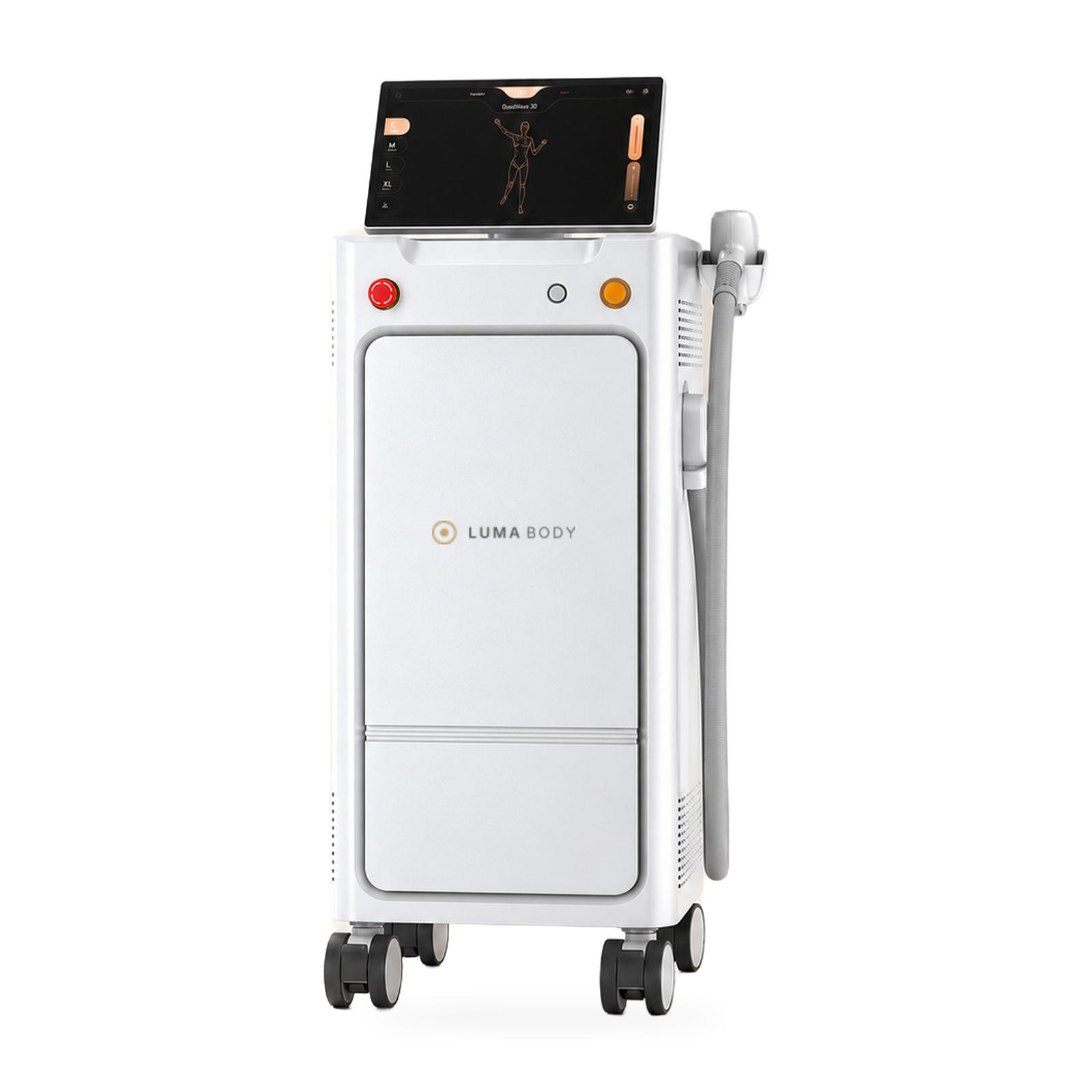
A vertical 1200W diode laser is the machine a clinic buys when hair removal is the business, not a side line. The LumaDiode Vertex is $10,320, final delivered price, with a 2-year machine warranty. Most buyers weigh it against two alternatives. The LumaDiode Compact is a desktop triple-wavelength unit at $7,120. The LumaDiode QuadWave is an 1800W four-wavelength platform at $15,920. All three are delivered to your practice in the US and Canada with nothing to pay on arrival.
This guide covers what the extra money for a floor-standing unit actually buys, and which of the three fits which clinic.
The three side by side
| Vertex | Compact | QuadWave | |
|---|---|---|---|
| Format | Floor-standing | Desktop, fits a trolley or counter | Console platform |
| Wavelengths | 755 + 808 + 1064nm | 755 + 808 + 1064nm | 755 + 808 + 940 + 1064nm |
| Power | 1200W laser | 100W bars, 2000W machine power | 1800W laser |
| Spot sizes | 12x24mm or 12x36mm | 12x20mm | 12x12, 12x24, 12x36mm, 6mm round |
| Pulse width | 1–200ms (up to 300ms) | 1–200ms | 10–125ms |
| Repetition rate | 1–10Hz | 1–10Hz | Up to 20Hz |
| Cooling | Water + air + compressor | Air + water circulation | Contact cooling held at 5C |
| Screen | 14" 4K touchscreen | 12" 4K touchscreen | 15.6" Android touchscreen |
| Voltage | 110V or 220V | 220V | 110V or 220V |
| Warranty | 2 years machine | 2 years machine, 1 year handpiece | 12 months machine, 3 months handpiece |
| Delivered price | $10,320 | $7,120 | $15,920 |
The Vertex and the Compact fire the same three wavelengths. The practical differences between them are spot size, cooling, footprint and power supply. On the QuadWave, the four-spot Clinic accessory package with the 6mm round tip is an option at extra cost, so check the configured price on its page.
Spot size is where the time goes
On a full leg or a back, the operator's time is mostly spent moving the handpiece across skin. Spot area decides how many pulses that takes.
| Spot | Area per pulse | Pulses per 1,000 cm², single pass, no overlap |
|---|---|---|
| 12x36mm | 4.32 cm² | about 232 |
| 12x24mm | 2.88 cm² | about 348 |
| 12x20mm | 2.40 cm² | about 417 |
Real protocols overlap and often use more than one pass, so the absolute numbers will be higher. The ratio holds, though: the Vertex's 12x36mm spot needs roughly 45% fewer pulses than the Compact's 12x20mm to cover the same area. Both machines top out at 10Hz, so the larger spot is the only thing doing that work.
On an upper lip or an underarm the gap closes. The area is small, and the larger spot can be harder to place. This is why the Vertex has a 12x24mm option, and why the Compact is a sensible machine for a practice whose bookings are mostly face, underarm and bikini.
A word on the other headline numbers. The Vertex lists fluence as 1–150 J/cm², the Compact lists energy as 1–150 J, and the QuadWave lists 5–40 and 5–30 J/cm². These are not measured the same way, and a bigger maximum on a spec sheet does not tell you which machine treats better. Ask for the fluence available at the spot size and pulse width you will actually use.
Cooling decides how long the machine keeps going
Diode bars turn a large share of their input into heat. The cooling system has to carry that heat away through a full day. When it cannot keep up, the operator waits for the handpiece to come back down to temperature.
- Vertex: water and air cooling with a compressor added. This is the main reason to buy a floor-standing unit if you book full legs and backs back to back.
- Compact: air and water circulation. This is adequate for shorter sessions and mixed small areas, but it has less margin for a day of large areas.
- QuadWave: contact cooling holds the skin-side window at 5C through the pulse. Its protocols run without gel.
One question is worth asking of any diode: at the repetition rate you will use, how long can the machine run before it slows or pauses to cool? Get the answer in writing.
Warranty: read the handpiece line
The handpiece holds the laser bars, and it is the part that wears.
- The Vertex carries a 2-year machine warranty. Handpiece terms are not listed separately, so confirm in writing what covers the handpiece before you order.
- The Compact carries 2 years on the machine and 1 year on the handpiece. The handpiece is rated for 40 million shots.
- The QuadWave carries 12 months on the machine and 3 months on handpieces. That shorter term is part of the trade for its extra power and fourth wavelength. Consumables and spares are available to order.
For any diode, ask for the handpiece's rated shot count and the price of a replacement handpiece. The other questions worth asking are in eleven things to check before buying any med-spa machine.
The room, the outlet and who operates it
Space. The Compact ships in a package of 49.5 x 38 x 38 cm and sits on a counter or trolley. That is what makes it the machine for small rooms and for practices that move a unit between locations. The Vertex is a full-size cart. Measure the treatment room, the doorways and any lift before you order, and ask us for the crate dimensions.
Power. The Vertex and the QuadWave can be configured for 110V 60Hz or 220V 50Hz. The Compact runs on 220V only, and in the US and Canada that means a 220–240V outlet. If your room only has standard outlets, the Vertex removes the electrician from the plan.
Operators. Who may perform laser hair removal, and under what supervision, varies by state and province. Confirm what applies where you practise before you plan staffing around the machine.
Who should buy which
Buy the Vertex if hair removal is a main revenue line and your book includes full legs, backs and chests. It also suits you if you want the longest machine warranty of the three and need to run on 110V. You are paying for the larger spot and the bigger cooling system. Both pay off in hours saved on large areas, not in what the laser can treat.
Buy the Compact if you are starting hair removal, or most of your bookings are faces, underarms, bikini and arms. It also suits rooms where a cart will not fit and practices that move a machine between sites. It uses the same three wavelengths at a lower price, and it is slower on large areas.
Buy the QuadWave if you want the most power and the widest spot range, including a 6mm round tip for small areas. It also suits you if you prefer contact cooling and gel-free protocols, or want 20Hz for speed. Accept the shorter warranty with it. For whether the 940nm wavelength matters to your client base, read 4 wavelength vs 3 wavelength diode laser.
There is also a middle option. The LumaDiode TriWave is a 1200W triple-wavelength diode in a more compact console with stacking mode and TEC cooling, at $10,320. Clinics that treat many full legs and backs usually prefer the Vertex's larger spot.
Before you order
All three triple- and four-wavelength machines are used across skin types I to VI. Settings on darker skin are lower in energy and longer in pulse, and that is covered in operator training. What the machine needs for that work is set out in laser hair removal on darker skin.
To work out when a machine earns back its cost, use your own prices and booking numbers in how fast a diode laser hair removal machine pays for itself. For the wider price picture, see what a diode laser hair removal machine actually costs. For what happens between order and delivery, read how buying a clinic machine direct works.