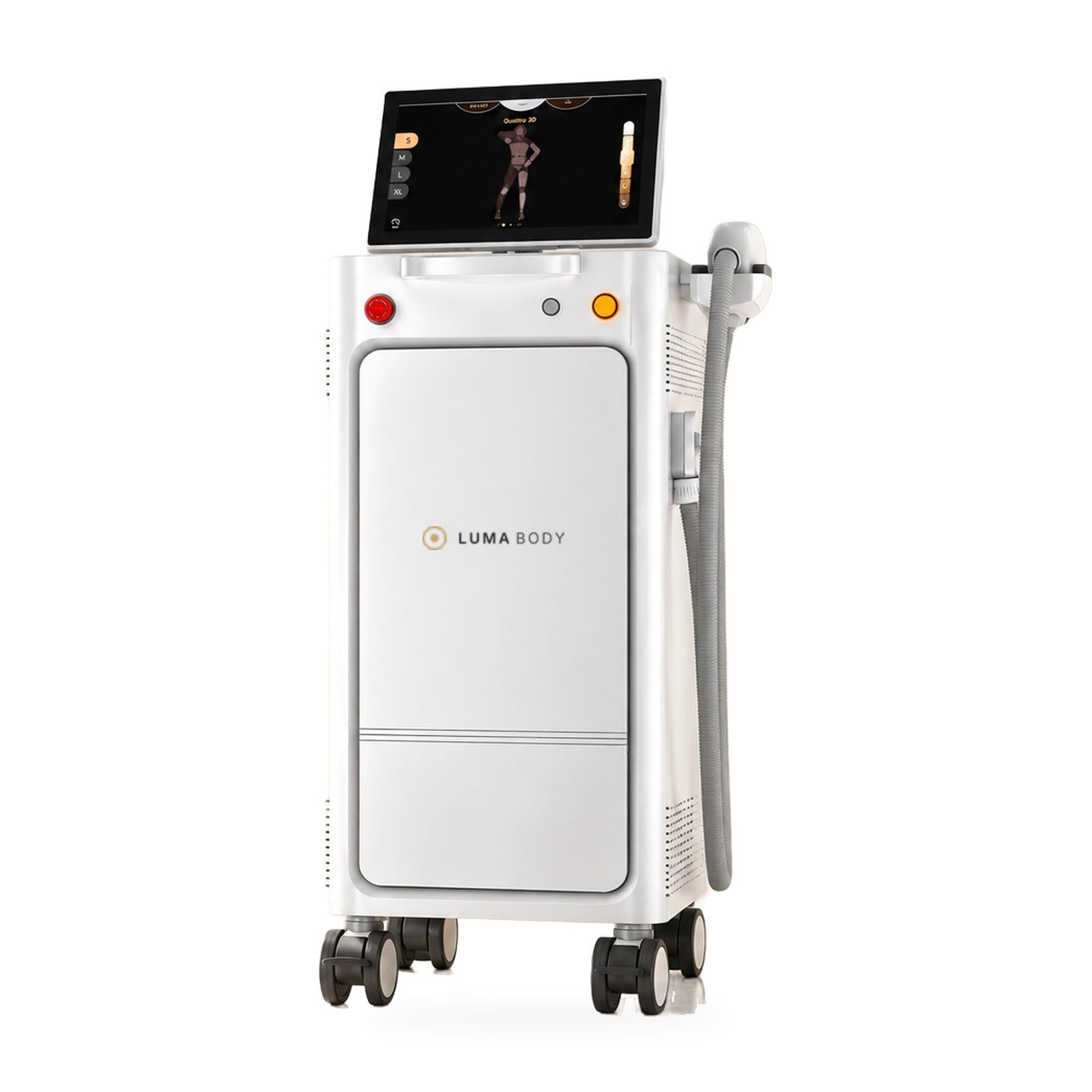
A one-room spa or a mobile practice needs a hair removal laser that fits on a counter or a trolley, does not need a plant room, and pays for itself on short appointments. A portable diode does that. It does not replace a full console in a clinic running hair removal all day, and the one that suits most small rooms comes with a wiring question you should settle before you order.
The portable and the console, side by side
The LumaDiode Compact is our portable unit. The LumaDiode TriWave is the full-size console most small clinics compare it with.
| LumaDiode Compact | LumaDiode TriWave | |
|---|---|---|
| Wavelengths | 755 + 808 + 1064nm | 755 + 808 + 1064nm |
| Laser output | 100 W per laser bar | 1200 W |
| Machine power draw | 2000 W | 2800 W |
| Spot size | 12x20mm | 10x20mm |
| Pulse width | 1–200 ms | 5–100 ms |
| Repetition rate | 1–10 Hz | Up to 10 Hz |
| Cooling | Air + water circulation | TEC |
| Screen | 12" 4K touchscreen | 15.6" touchscreen |
| Voltage | 220V 50/60Hz only | 110V 60Hz or 220V 50Hz |
| Warranty | 2 years machine / 1 year handpiece | 12 months machine / 3 months handpiece |
| Price | $7,120 | $10,320 |
Both are delivered to your practice, nothing to pay on arrival, with online operator training for your team.
What a portable diode does well, and where it runs out
On wavelengths the Compact gives up nothing: 755nm for fine and light hair, 808nm for most of a treatment plan, 1064nm for deeper follicles and darker skin. That covers skin types I to VI from one handpiece. For what darker skin asks of a machine, read laser hair removal on darker skin.
On spot size it is not the smaller machine. Its 12x20mm spot is slightly larger than the TriWave's 10x20mm. What the console buys you is laser output and cooling. The TriWave's 1200 W and TEC-cooled tip are built for long in-motion passes on legs, backs and chests, one client after another. The Compact treats those areas too, but more slowly, and it is not designed for a schedule of back-to-back full legs.
In practice:
- Face, underarms, bikini, arms: the Compact is fast and economical. This is where most small-spa bookings are.
- Full legs, backs, chests now and then: the Compact handles them. Price those appointments for the extra time.
- Large areas most of the day: buy a console. The LumaDiode Vertex, $10,320, is our floor-standing unit with a larger spot and stronger cooling. The trade-offs are covered in vertical 1200W diode vs compact.
The 220V question in a US or Canadian room
The Compact runs on 220V only. Most outlets in a US or Canadian treatment room are 110-120V. The Compact will not run from them, and there is no setting that changes that.
The arithmetic explains why. At 2000 W, the machine would draw about 17 amps at 120V, more than a standard 15-amp outlet circuit can supply. At 240V it draws about 8.3 amps, well within an ordinary dedicated circuit.
What that means for you:
- Check the room first. If there is already a 240V outlet, the kind a dryer or oven uses, you may be ready. Confirm the outlet type with us before ordering.
- If there is no 240V outlet, a qualified electrician can usually add a dedicated circuit. Get the quote before you buy and add it to the machine price in your payback maths.
- Commercial buildings sometimes supply 208V rather than 240V. Ask us to confirm before you wire.
- Do not improvise with adapters or plug-in converters.
- If adding a 240V circuit is not possible, for example in a rented room where the landlord will not allow it, the TriWave is offered in a 110V 60Hz version. At 2800 W it still needs a circuit that can carry the load, so have the room checked either way.
Taking it mobile
The Compact's package is 49.5 x 38 x 38 cm, roughly 19.5 x 15 x 15 inches. It fits on a trolley or a counter and in the back of a car. For a practice that moves between two or three locations, that is the main reason to buy it.
The limit on a mobile route is power, not size. Every room you treat in needs a 220-240V outlet within reach of the treatment couch. Check each site before you book clients there. Hotel rooms, clients' homes and shared salon suites often have none.
The Compact also has a water circulation loop. Ask us how to prepare it for transport before you plan regular moves.
Rules on who may operate a laser, under what supervision, and whether laser treatments may be done outside a fixed premises vary by state and province. Confirm what applies where you practise before you set up a mobile service.
Price and warranty
The LumaDiode Compact is $7,120, delivered, nothing to pay on arrival. The TriWave is $10,320, and a single-808nm configuration of it is available at a lower price.
The warranty difference matters more in a small business than it looks:
- Compact: 2 years on the machine, 1 year on the handpiece. The handpiece is rated for 40 million shots.
- TriWave: 12 months on the machine, 3 months on the handpiece.
For a one-room spa without a second machine to fall back on, two years of machine cover is real protection. For what any purchase price should include, see what a diode laser hair removal machine actually costs.
Payback at realistic session prices
These are assumptions, not promises. Replace them with your own numbers.
Session price. Small-area diode hair removal in many US markets is priced at roughly $50-$75 for upper lip or chin, $75-$150 for underarms, and $100-$200 for bikini. Lower legs cost more. Most clients buy a course, usually at a package discount. We assume an average of $100 per session after discounts.
Cost per session. Gel, couch roll and distilled water for the cooling circuit come to about $5. Electricity is negligible at this scale.
Margin per session: $100 − $5 = $95, if the owner does the treatments.
Sessions to break even: ($7,120 + your electrician's quote) ÷ $95.
Monthly contribution:
| Sessions per week | Sessions per month (× 52 ÷ 12) | Monthly contribution at $95 |
|---|---|---|
| 6 | 26 | $2,470 |
| 12 | 52 | $4,940 |
| 20 | 87 | $8,265 |
Months to pay back = (delivered price + electrical work) ÷ monthly contribution from the row that matches your bookings.
If a staff member does the treatments on 30% commission, the margin falls to $100 − $30 − $5 = $65. Redo the division with that figure. Six sessions a week is a modest target for a spa that already has a client list. The risk is in the first months, while your existing clients are still learning you offer hair removal.
For a fuller model, including slow months and package pricing, read how fast a diode laser hair removal machine pays for itself.
Who should buy which
- One-room spa, mostly small areas, a 240V outlet available or easy to add: the LumaDiode Compact.
- Mobile practice moving between sites that all have 240V: the Compact. Nothing else in our range is this easy to carry.
- Small clinic with steady large-area bookings, or a room that can only have 110V: the LumaDiode TriWave.
- Hair removal as the main business, all day: a console. Start with choosing a diode laser for a med spa.
Before you order, run through eleven things to check before buying any med-spa machine. If you are new to buying direct, read how buying a clinic machine direct works.